- Don's Trading Desk
- Posts
- Stop Blowing Up Your Account!
Stop Blowing Up Your Account!
(it's time to get this right)

Don Kaufman
January 14, 2025

Don Kaufman here.
And it’s time to get real for a second.
You want to trade? Fine.
But if you don’t have a handle on your risk management, you’re not a trader—you’re a gambler. And trust me, the market is not a friendly casino.
The market’s job is to hurt the most people possible, and if you’re out there trading without a plan, guess what? You’re the target.
Look, I don’t care if you’ve got the best chart setup, the hottest stock pick, or a “sure thing” tip.
None of it matters if you can’t manage your risk. Because the moment you blow up your account, you’re done. Game over. No more trades. No more chances. And the market? It doesn’t care.
So let’s talk about how not to blow up your account. Let’s talk about risk management—because this is what separates the pros from the amateurs.
Why Risk Management Matters (Spoiler: It’s Everything)
Here’s the deal: The market is chaos.
It doesn’t care about your feelings, your hopes, or your “perfect trade idea.” It’s unpredictable, volatile, and designed to shake you out.
Take today’s markets, for example. We’re getting wild swings off PMI data, bonds are collapsing into the abyss, and everyone’s bracing for the next CPI report.
The S&P futures?
They’re bouncing around like a toddler on a sugar high…
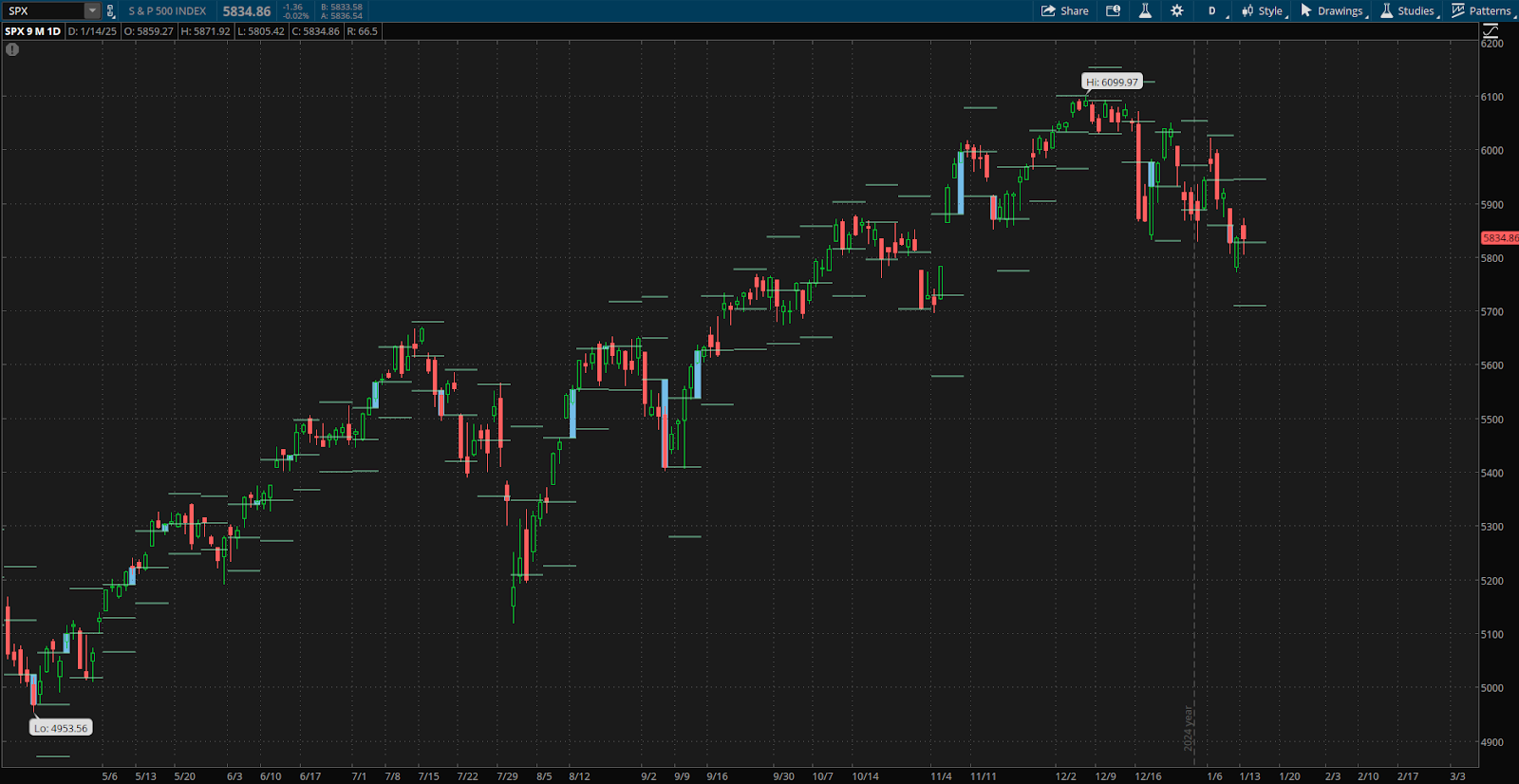
If you’re not managing your risk in this environment, you’re toast. Period.
Rule #1: Protect Your Capital Like Your Life Depends on It
Let me be blunt: If you blow up your account, you’re out of the game. No more trades, no more opportunities to make money. Your number one job as a trader isn’t to make money—it’s to survive.
That means:
Never risk more than 1-5% of your account on a single trade.
Know your downside before you even think about your upside.
Example: If you’ve got a $10,000 account, your max risk on a trade should be $100-$500.
Not $1,000, not $5,000—$100-$500. I don’t care how “sure” you are about a trade.
You’re not betting the farm, because this isn’t Vegas.
Rule #2: Use a Stop-Loss (And Don’t Be Stupid About It)
Let me say this loud and clear: No stop-loss = no business trading. I don’t care if you’re trading the S&P futures, Tesla, or Dogecoin—if you’re not using a stop, you’re playing with fire.
Here’s why:
A stop-loss protects you from yourself.
It forces you to admit when you’re wrong and cut the trade before it wrecks you.
But here’s the catch: You’ve got to place your stops smartly.
Don’t put them too tight. In a volatile market, you’ll get stopped out constantly.
Don’t put them too wide without adjusting your position size. Your risk still has to make sense.
For example: If you’re trading the S&P 500 futures and you’re placing a stop 15 points away, size down your position to keep your risk under control.
Don’t be the idiot who trades the same size with wider stops and then wonders why their account is bleeding out.
Another thing that helps me is trading options with defined risk. When you trade something like spreads, they have built in stops, limiting your risk to the amount of capital you put in.
Rule #3: The Market Rewards Patience (Not FOMO)
Here’s the thing about volatile markets: They’re full of fakeouts.
The market will spike, dip, reverse, and do everything it can to lure you into chasing bad trades. And if you’re not disciplined, you’re going to fall for it.
Stop chasing every move.
Wait for confirmation before you enter a trade.
For example: When the S&P approaches a key level like 5911, don’t just jump in assuming it’ll hold.
Watch how the market reacts.
Is it bouncing? Breaking? Consolidating?
Let the market show you its hand before you make your move.
Rule #4: Risk-to-Reward Ratios Are Non-Negotiable
Every trade you take should have a clear risk-to-reward ratio, and if it doesn’t, you’re doing it wrong.
Here’s the math: For every $1 you risk, you should aim to make at least $2. That’s a 1:2 ratio, and it’s the bare minimum. Why? Because even if you’re wrong half the time, you’ll still come out ahead.
Bad Trade: Risking $100 to make $50. (Stop doing this.)
Good Trade: Risking $100 to make $200 or more. (This is how you win.)
If the trade doesn’t meet your risk-to-reward criteria, skip it. There’s always another opportunity.
Rule #5: Position Sizing Is the Secret Sauce
Look, you can have the best entry, the perfect stop-loss, and the ideal setup, but if your position size is too big, none of that matters.
Position sizing is how you control your risk. It’s how you survive those inevitable losing trades without blowing up your account.
Here’s a simple formula:
Position Size = Risk Amount ÷ Stop-Loss Distance
Example: If your max risk is $100 and your stop is 10 points away, your position size should be 10 shares and if you are trading options only do one contract if it’s priced at $1 in premium.
And don’t forget: In volatile markets, widen your stop but reduce your position size. This keeps your risk consistent while giving your trade room to breathe.
Rule #6: Don’t Be Afraid to Hedge
If you’re trading in this market without hedges, I don’t know what to tell you. Options are your best friend in volatile markets, and if you’re not using them, you’re leaving money (and safety) on the table.
Here are some ideas if you’re holding a longterm basket of stocks:
Buy Puts: Protect your long positions from sudden drops.
Use Spreads: Cap your risk and reward with strategies like iron condors or butterflies.
Short the Weak: If you’re long the overall market, hedge by shorting weaker sectors like retail or discretionary stocks.
Hedging isn’t about being “right” on every trade. It’s about staying alive when the market goes against you.
Rule #7: Know When to Walk Away
Here’s a pro tip: You don’t have to trade every day. If the market’s too chaotic, or if you’re not seeing clear setups, step back. The market isn’t going anywhere.
Signs you need to take a break:
You’re revenge trading after a loss.
You’re taking trades out of boredom.
You’re ignoring your own rules.
Remember: The best traders aren’t the ones who trade the most—they’re the ones who trade the best.
Don’t Just Survive—Thrive in the Markets
Listen, the market isn’t going to wait for you to figure things out. The chaos, the volatility—it’s always there, and it’s not going anywhere. The question is: Are you prepared to navigate it?
If you’ve been trading without a plan, without a strategy, and without the tools needed to manage your risk, it’s only a matter of time before the market chews you up and spits you out. But it doesn’t have to be that way.
I’ve spent my career dissecting what works for traders, especially those starting with small accounts. And one thing is clear: You need a system that’s simple, repeatable, and built to keep you in the game.
This is your chance to:
Trade with confidence, knowing your risk is defined.
Grow your account steadily—even if you’re starting small.
Learn directly from me, with weekly trades, updates, and a proven strategy that works.
Stop gambling. Stop guessing. Start trading with the kind of precision and discipline that separates pros from amateurs.
Let’s take on the market together. This is your moment—don’t let it slip away.
To your success,
Don Kaufman
Forget Luck—Discover the Proven Earnings Season Pattern Printing Triple-Digit Winners
Think earnings season is a coin flip? Think again.
While most traders are getting whiplash from wild market swings, a small group of smart traders is quietly locking in triple-digit profits.
Take last Friday, for example. Don Kaufman closed a 122% profit on DAL—on a day when the Dow tanked nearly 700 points.
This isn’t luck. It’s not some secret Wall Street magic.
It’s a repeatable pattern that shows up like clockwork during earnings season.
We’re talking:
348% on AMZN.
182% on AAPL.
And triple-digit winners on trades you could set up in minutes.
Now, you can learn this exact strategy.
Why earnings option premiums create a short but powerful “profit window.”
How to spot the predictable pattern that shows up 24 hours before a big move.
A simple game plan to find and execute your next trade with confidence.
Earnings season is heating up, and the opportunities are knocking.
Don’t sit on the sidelines while everyone else cashes in.