- Don's Trading Desk
- Posts
- Unlock the Secret to Better Options Trading
Unlock the Secret to Better Options Trading

Roman Hreskiv
July 05, 2024
Unlock the Secret to Better Options Trading
One thing that many traders get wrong when it comes to options trading is their strategy selection.
They’ll buy straight calls (or puts) when trading directionally vs. trading spreads…
Or do spreads when they should be buying outright options.
Throughout my career I’ve seen millions of trading accounts…and I can’t tell you how much money was left on the table.
A LOT.
So what do you need to know to level up your options game?
First, you want to pay attention to the options implied volatility.
This tells us how much the options market is expecting a specific stock or ETF to move.
For example, if you take a look at red-hot Tesla you can see some interesting things in the options market.
The current implied volatility for Tesla options is 65.3%.
Implied volatility is expressed in annual terms, which can be hard to grasp.
But if you take the annualized implied volatility and divide it by 15.87, which is the square root of the number of trading days in a typical year (252) you can convert it to implied daily volatility.
In this case the daily options implied volatility is 4.1%
And while it has moved higher than that a few times this week, you have to ask yourself, is it sustainable?
To better answer that question, it’s best to compare the implied volatility to what it’s done over the last year.
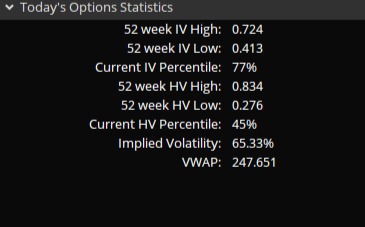
You can find this on the thinkorswim platform for free, and most option trading platforms offer it as well.
The 52-week high implied volatility for Tesla options is 72.4%...and our current implied volatility is 65.3%.
In other words, option volatility in Tesla is relatively high.
In fact, it’s in the 77% percentile.
Equipped with this knowledge, you probably don’t want to buy outright options. If you have a directional bias, a spread trade is a better bet based on the current volatility.
However, there’s another reason why trading a spread is better, especially if you are bullish Tesla right now.
It’s called Skew.
Most equities have a negative skew.
That means the farther OTM calls have a lower implied volatility than the atm money options.
Why?
Because institutions who own the stock sell calls against their stock to collect premium and hedge some of their risk.
The selling of calls makes the implied volatility go down in OTM options.
However, that’s not what we are seeing with Tesla options right now.
Tesla call options have a positive skew.
In other words, institutions aren’t selling calls in OTM options, they are actually buying them.
The buying pressure is causing the OTM call options spike in implied volatility.
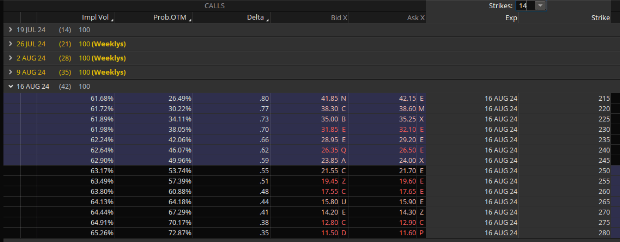
This makes it even more advantageous to buy call spreads if you’re bullish.
Because you are selling the more expensive option and collecting a bigger premium.
I believe if you start analyzing implied volatility and skew into your decision making it will make you a better options trader.
To your success,
Don Kaufman
P.S. 90% of all trades are placed by algorithms. If you could better understand how they move utilizing the power of AI, do you think it would make you a better trader? Click here to learn more.
P.P.S. I was on TheoTrade Live this morning discussing Tesla and a whole lot of other topics with Brandon and Blake. If you missed our session, you can catch the replay here.